
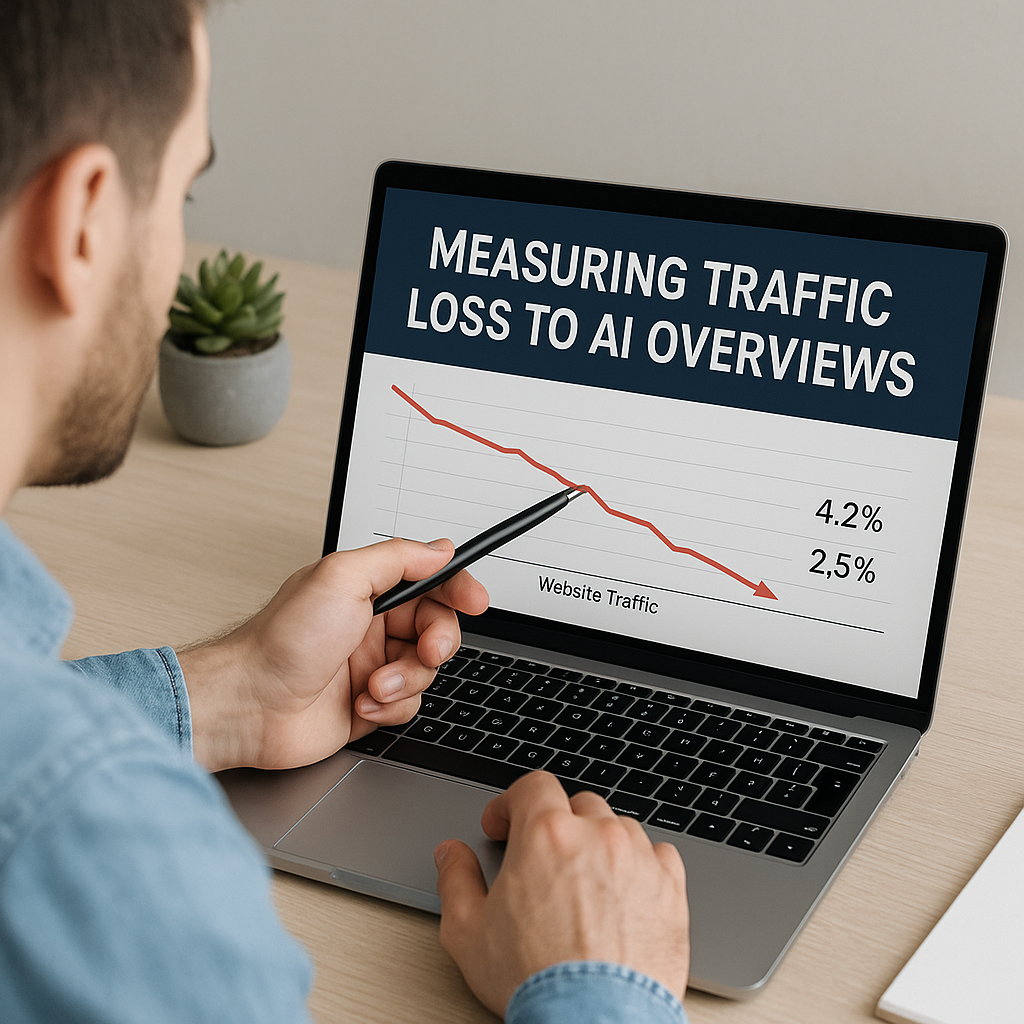
How To Measure Traffic Lost To AI Overviews matters most when your health content answers questions Google can now summarize instantly. If your diabetes, nutrition, cardiovascular health, or mental health articles suddenly earn fewer clicks but still show impressions, this guide shows you how to estimate the loss, validate the cause, and respond without guessing.
How To Measure Traffic Lost To AI Overviews in Health Search
To estimate traffic lost to AI Overviews, compare affected health keywords before and after AI Overviews appeared, using Google Search Console impressions, clicks, click-through rate, rankings, and query intent. Then separate normal ranking changes from zero-click behavior by checking whether impressions stayed stable while clicks declined.
Health publishers face a special challenge. Many searches, such as “symptoms of high blood pressure,” “foods for prediabetes,” or “is magnesium good for sleep,” can trigger AI-generated summaries. As a result, readers may get a quick answer without clicking through to your article.
However, not every traffic drop comes from AI Overviews. Algorithm updates, stronger competitors, seasonal demand, and content freshness can also reduce visits. Therefore, the best approach is not a single metric. You need a repeatable measurement model that compares search demand, visibility, and click behavior.
Start by grouping pages into health intent categories. For example, symptom pages often behave differently from treatment explainers, supplement articles, or condition guides. According to research on search behavior, users are less likely to click when the answer appears complete on the results page. This is especially common for simple medical definitions and “what is” queries.
Why AI Overviews Reduce Clicks on Medical and Wellness Content
AI Overviews can reduce organic clicks because they answer the first layer of a health question directly in search results. However, they do not remove the need for trustworthy medical content. In fact, readers often still click when they need depth, safety context, risk factors, or help deciding what to ask a healthcare provider.
Health websites are more exposed because many medical topics follow a predictable question-and-answer format. For example, Google may summarize common symptoms, possible causes, lifestyle tips, or general prevention advice.
Traffic loss is more likely when your content targets:
- Simple definitions, such as “what is hypertension” or “what is insulin resistance”
- Short symptom queries, such as “dehydration symptoms” or “thyroid fatigue signs”
- Basic nutrition questions, such as “foods high in potassium”
- General wellness topics, such as sleep hygiene, stress, or hydration
- Quick comparison queries, such as “cold vs flu symptoms”
Meanwhile, traffic may remain stronger for content that includes original medical review, clinical nuance, expert quotes, patient experience, decision trees, or updated safety information. For YMYL topics, Google still needs reliable sources that help users avoid harm.
Importantly, AI summaries can sometimes omit context. For example, advice about sodium intake, supplements, pregnancy, kidney disease, diabetes medication, or blood pressure can carry risks for certain people. Therefore, health content should clearly explain when readers should consult a healthcare provider instead of relying on a general search answer.
How To Measure Traffic Lost To AI Overviews Using Search Console Data
The cleanest way to begin is with Google Search Console. It does not currently provide a direct “AI Overview click loss” report for every site. However, it gives enough data to estimate the impact with reasonable confidence.
Use this process for How To Measure Traffic Lost To AI Overviews across your health content:
- Choose a comparison period, such as 28 days before and 28 days after a suspected AI Overview change.
- Export page-level and query-level data from Google Search Console.
- Filter for informational health queries that previously drove meaningful clicks.
- Compare impressions, average position, clicks, and CTR for each query.
- Flag queries where impressions stayed flat or increased, rankings stayed similar, but CTR fell sharply.
- Manually search priority queries in an incognito window to see whether an AI Overview appears.
- Estimate lost clicks by applying the old CTR to current impressions, then subtract actual clicks.
For example, if a query previously had 20,000 impressions and a 6 percent CTR, you expected 1,200 clicks. If current impressions remain 20,000 but CTR drops to 3 percent, you now receive 600 clicks. The estimated loss is 600 clicks for that query.
This method is not perfect. Search results vary by location, device, and personalization. However, it creates a practical baseline. Moreover, it helps you separate AI Overview traffic loss from ranking decline.
What Signals Show AI Overviews Are Taking Your Health Traffic?
Several patterns suggest AI Overviews may be reducing your clicks. The most important signal is a CTR drop without a matching ranking drop. If your page still ranks in the top three but earns fewer clicks, the search result page itself has changed.
Look for these signs:
- Stable or rising impressions with declining clicks
- Average position staying within a similar range
- Bigger losses on mobile than desktop
- Greater declines on short informational queries
- Smaller losses on long-tail, high-intent medical questions
- Traffic drops beginning near known search feature expansion dates
A common question is, “Can Google Search Console show AI Overview traffic directly?” Not reliably for most publishers. Search Console shows the outcome, not always the feature responsible. Therefore, you need to combine Search Console exports with manual SERP checks, analytics data, and keyword tracking tools that monitor AI Overview presence.
Another useful question is, “How do I know if AI Overview reduced my organic traffic?” The answer is pattern matching. If impressions and rankings remain steady while CTR falls on queries that now display AI summaries, AI Overview exposure is a likely factor.
For health sites, also compare the type of query. A page about “early signs of type 2 diabetes” may lose quick-answer clicks. However, a page about “when to see a doctor for high blood sugar symptoms” may still attract readers because it addresses risk, urgency, and decision-making.
Risks of Misreading AI Overview Traffic Loss in Health SEO
Measuring search loss incorrectly can lead to poor content decisions. For example, a publisher may delete useful pages because clicks fell, even though those pages still build authority, earn brand visibility, or support safer health decisions.
There are also patient-safety risks. If a site rewrites medical content only to win clicks, it may remove important cautions. That can be harmful for readers with chronic conditions, pregnancy, kidney disease, cardiovascular risk, or medication interactions. Experts recommend keeping clinical accuracy ahead of click optimization.
Do not assume AI Overviews are always the problem. Before making major changes, check for:
- Recent Google core updates or helpful content changes
- Loss of backlinks or internal links
- Outdated medical statements or missing review dates
- Competitors with stronger E-E-A-T signals
- Seasonal search changes, such as flu, allergies, or weight-loss trends
In addition, review whether your article answers the full user journey. A thin page that only defines cholesterol will struggle. Conversely, a strong article may explain LDL, HDL, triglycerides, cardiovascular risk, lifestyle factors, testing, and when to speak with a clinician.
Health content should never present search data as medical advice. If you publish condition, symptom, medication, or supplement content, have qualified experts review it where appropriate. Readers should consult a healthcare provider for personal diagnosis, treatment, or concerns about side effects and contraindications.
Practical Tips to Recover After You Measure AI Overview Traffic Loss
Once you estimate the loss, prioritize pages where traffic decline affects business goals or patient education value. Then improve the page so it offers something an AI summary cannot fully replace.
- Add medically reviewed explanations with reviewer credentials and update dates.
- Include practical decision support, such as red flags, questions to ask a doctor, or testing considerations.
- Expand beyond basic definitions with causes, risk groups, prevention, and safety notes.
- Use original charts, expert quotes, patient-friendly checklists, or condition-specific examples.
- Strengthen internal links from related topics, such as diabetes, hypertension, nutrition, and heart health.
- Optimize titles for deeper intent, not just quick answers.
For example, instead of only targeting “low iron symptoms,” consider adding sections on iron deficiency anemia, menstruation, pregnancy, gastrointestinal bleeding, fatigue, ferritin testing, and when symptoms need medical attention. This gives readers context that a short AI result may not cover.
Similarly, a nutrition article can explain food sources while also noting that some people, such as those with kidney disease, may need individualized guidance. This balanced approach supports trust and may improve engagement.
Another long-tail question worth answering is, “What metrics should health sites track after AI Overviews appear?” Track organic clicks, impressions, CTR, average position, engaged sessions, scroll depth, conversions, newsletter signups, branded search growth, and returning visitors. Consequently, you measure both lost clicks and retained audience value.
How Often Should Health Publishers Recheck AI Overview Impact?
Recheck priority queries at least monthly, and faster after major Google updates. AI Overview coverage changes often. A query that triggers an AI summary today may not trigger one next week. Likewise, Google may cite different sources over time.
Create a simple dashboard with three groups:
- High-impression queries showing CTR declines
- Pages with stable rankings but falling clicks
- Medical topics where accuracy, safety, and freshness matter most
Then review the pages with the highest loss estimates first. In addition, monitor whether your brand gets mentioned or cited in AI summaries. Even when clicks fall, brand visibility can still support trust, especially for health publishers with strong medical review standards.
Finally, keep improving content quality. Studies suggest users prefer sources that explain uncertainty, cite expertise, and help them make safer decisions. Therefore, your content should answer the quick question and the smarter follow-up question.
How To Measure Traffic Lost To AI Overviews is not about blaming one search feature for every decline. It is about using data to protect helpful health content. Compare impressions, rankings, CTR, and SERP features, then improve pages with medical depth, safety context, and real user value. That is the most reliable path forward for How To Measure Traffic Lost To AI Overviews.