
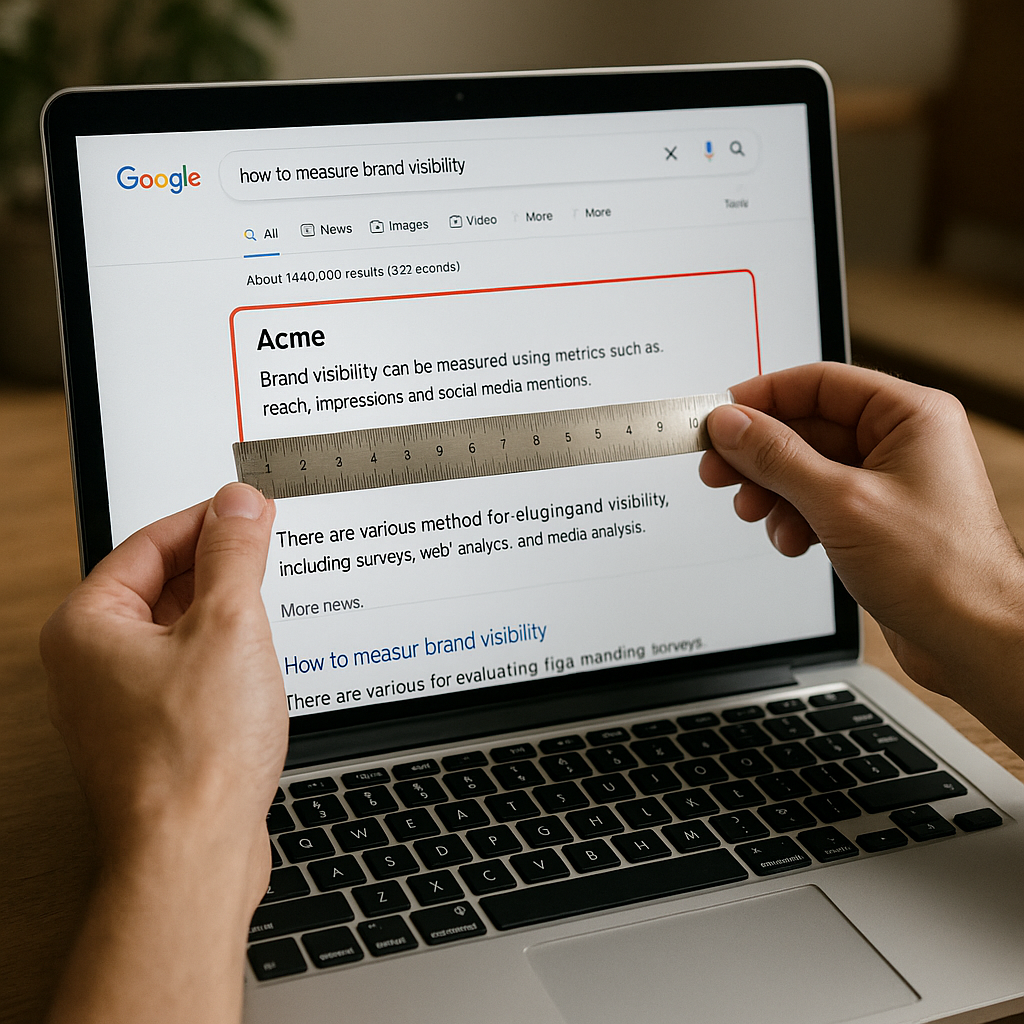
How To Measure Brand Visibility In AI Answers matters because patients, caregivers, and clinicians increasingly ask AI tools health questions before they visit a website. If your hospital, clinic, supplement brand, or health publisher is missing from those answers, you may be invisible at the exact moment trust is being formed.
How To Measure Brand Visibility In AI Answers for Healthcare Brands
To measure brand visibility in AI answers, track how often your brand appears, how accurately it is described, where it ranks in the response, whether competitors are mentioned instead, and whether the answer cites trusted sources. For health topics, also review medical accuracy, safety language, and alignment with clinical consensus.
AI answer visibility is the new layer between search intent and website traffic. Traditional SEO tells you where a page ranks on Google. However, AI visibility shows whether generative search tools, chatbots, and AI summaries recognize your brand as a trusted source.
For healthcare organizations, this matters more than in many industries. A patient searching for “best diabetes education program near me” or “is chest pain always serious” may see an AI-generated summary before clicking any result. If the answer names your competitor, cites their content, or ignores your medically reviewed pages, your authority is not converting into visibility.
Importantly, this is not just a marketing issue. Health content is YMYL content, which means accuracy can affect medical choices, medication safety, symptom interpretation, mental health decisions, and care-seeking behavior. Therefore, measuring AI answer visibility should include both brand presence and patient-safety review.
What Metrics Show Whether Your Brand Appears in AI Health Answers?
The strongest measurement system combines visibility, sentiment, share of voice, source quality, and medical accuracy. Moreover, you need to test across several prompt types because AI tools respond differently to education, comparison, local, and urgent-care questions.
- How To Measure Brand Visibility In AI Answers: record brand mentions, citation frequency, answer position, accuracy, competitor mentions, and referral traffic from AI surfaces.
- Brand mention rate, which shows how often your organization appears across repeated prompts.
- AI share of voice, which compares your visibility against competitors, associations, hospitals, clinics, and publishers.
- Citation quality, including whether AI references your website, peer-reviewed research, government sources, or unverified pages.
- Sentiment and framing, such as whether your brand is described as trusted, specialized, local, affordable, or evidence-based.
- Medical safety alignment, including whether AI answers mirror current clinical guidelines and avoid risky claims.
According to research on search behavior, users often trust highly placed answers more than lower-ranked links. As a result, a brand mentioned in the first sentence of an AI response may gain more authority than a brand listed near the end. Similarly, a cited source may be more valuable than an uncited mention because it signals that the AI system associates your content with evidence.
How To Measure Brand Visibility In AI Answers With Prompt Testing
Prompt testing is the most practical starting point. Instead of asking one generic question, create a prompt set that reflects real patient, caregiver, and clinician behavior. This helps you see whether your brand appears when users ask about symptoms, conditions, services, prevention, nutrition, or treatment options.
For example, a cardiology clinic might test prompts around high blood pressure, cholesterol, chest pain, cardiovascular disease prevention, and cardiac rehabilitation. Meanwhile, a women’s health practice might test questions about pelvic pain, menopause symptoms, fertility support, and preventive screenings.
Use these prompt groups to track How To Measure Brand Visibility In AI Answers in a repeatable way:
- Informational prompts, such as “What are early signs of type 2 diabetes?”
- Local-intent prompts, such as “best asthma specialist near me.”
- Comparison prompts, such as “hospital A vs hospital B for orthopedic surgery.”
- Trust prompts, such as “most reliable source for medication side effects.”
- Decision prompts, such as “when should I see a doctor for persistent fatigue?”
Run each prompt several times across tools like Google AI Overviews, Perplexity, ChatGPT, Gemini, Copilot, and other AI search experiences relevant to your audience. Then log the answer, date, tool, brand mentions, competitor mentions, citations, and any medical issues. Because AI answers can change, repeat testing weekly or monthly.
Why Does Your Healthcare Brand Not Appear in AI Answers?
Your brand may be absent because AI systems cannot clearly connect your content with trusted entities, topical expertise, or user intent. In addition, thin pages, unclear authorship, weak citations, duplicate service content, and missing medical review signals can reduce visibility.
Experts recommend strengthening the evidence trail behind health content. That means every major condition page should show who wrote or reviewed it, when it was updated, what sources support it, and when readers should seek professional care. For example, content about depression, pregnancy, cancer screening, diabetes medication, or blood pressure should never imply that online information replaces a clinician’s evaluation.
Studies suggest that consistency across the web also helps systems understand a brand. Therefore, your organization name, locations, clinicians, specialties, and services should match across your website, Google Business Profile, medical directories, academic profiles, and trusted third-party mentions.
Common visibility gaps include:
- No clear medical reviewer or expert author on health pages.
- Service pages that focus on marketing claims instead of useful patient answers.
- Weak internal linking between symptoms, conditions, treatments, and specialists.
- Outdated content that does not reflect current guidelines or safety advice.
- Few authoritative mentions from journals, associations, universities, or local health systems.
What Tools Can Track AI Answer Visibility and Mentions?
You can measure AI search visibility manually, with enterprise brand monitoring tools, or with specialized platforms that track generative engine optimization. However, manual review remains important for health topics because a dashboard may miss unsafe wording, missing contraindications, or misleading treatment claims.
Good tracking sources include AI search testing tools, rank-tracking platforms with AI features, Google Search Console, analytics referral data, social listening tools, and citation monitoring. In addition, set up alerts for branded terms, clinician names, flagship services, and high-risk content areas like medication safety, symptoms of stroke, pregnancy complications, and mental health crisis resources.
For a simple scorecard, rate each AI answer from 0 to 5 for brand presence, accuracy, citation quality, competitor advantage, and patient safety. Then compare scores over time. This makes How To Measure Brand Visibility In AI Answers easier for marketing, compliance, medical, and executive teams to understand.
What Are the Risks of Optimizing Health Content for AI Answers?
The main risk is chasing visibility without protecting accuracy. Healthcare brands should not manipulate AI answers, exaggerate outcomes, or publish unsupported claims. Instead, they should improve clarity, evidence, and usefulness. A page about supplements, for example, should mention possible side effects, interactions, and the importance of speaking with a healthcare provider before use.
There are also compliance risks. Depending on your location and organization type, content may need review for privacy, advertising rules, professional standards, and medical claims. Moreover, patient testimonials, before-and-after statements, and treatment descriptions can create legal or ethical concerns if they imply guaranteed results.
If AI answers misrepresent your brand, document the issue. Then improve the source content, update structured data, correct directory listings, and request corrections when platforms allow it. However, never publish medical content solely to influence AI systems. The first goal should be safer, clearer patient education.
Practical Steps to Improve AI Visibility Without Sacrificing Medical Trust
- Audit your highest-value health pages for authorship, review dates, citations, and clear medical safety language.
- Build topic clusters around conditions, symptoms, diagnostics, treatment options, prevention, and when to seek care.
- Use plain language, because AI systems often summarize content that directly answers patient questions.
- Add expert quotes or reviewer credentials where appropriate, especially for YMYL topics.
- Compare AI answers monthly and record whether your brand, competitors, and trusted sources appear.
- Escalate inaccurate or risky medical summaries to clinical reviewers before making content changes.
In addition, include balanced language on conditions and therapies. For example, say a treatment “may help some patients” rather than promising a cure. Likewise, explain that symptoms such as chest pain, sudden weakness, severe allergic reactions, or suicidal thoughts require urgent professional help. This supports trust and reduces harm.
How Often Should You Measure AI Answer Visibility?
Most healthcare brands should measure monthly, while high-competition or high-risk categories may need weekly checks. For example, hospitals, telehealth platforms, fertility clinics, mental health providers, and supplement companies may see frequent answer changes because AI systems update sources, summaries, and citations.
After major content updates, wait several days to several weeks before judging impact. Meanwhile, track traditional SEO signals too. AI visibility often improves when your website gains stronger entity signals, better rankings, more authoritative mentions, and clearer medical information architecture.
The practical takeaway is simple: How To Measure Brand Visibility In AI Answers requires more than counting mentions. For healthcare brands, the winning approach combines prompt testing, citation analysis, competitor comparison, and clinical accuracy review. When your content is useful, evidence-based, and easy for AI systems to understand, your brand has a better chance of appearing where patients are already asking questions.