

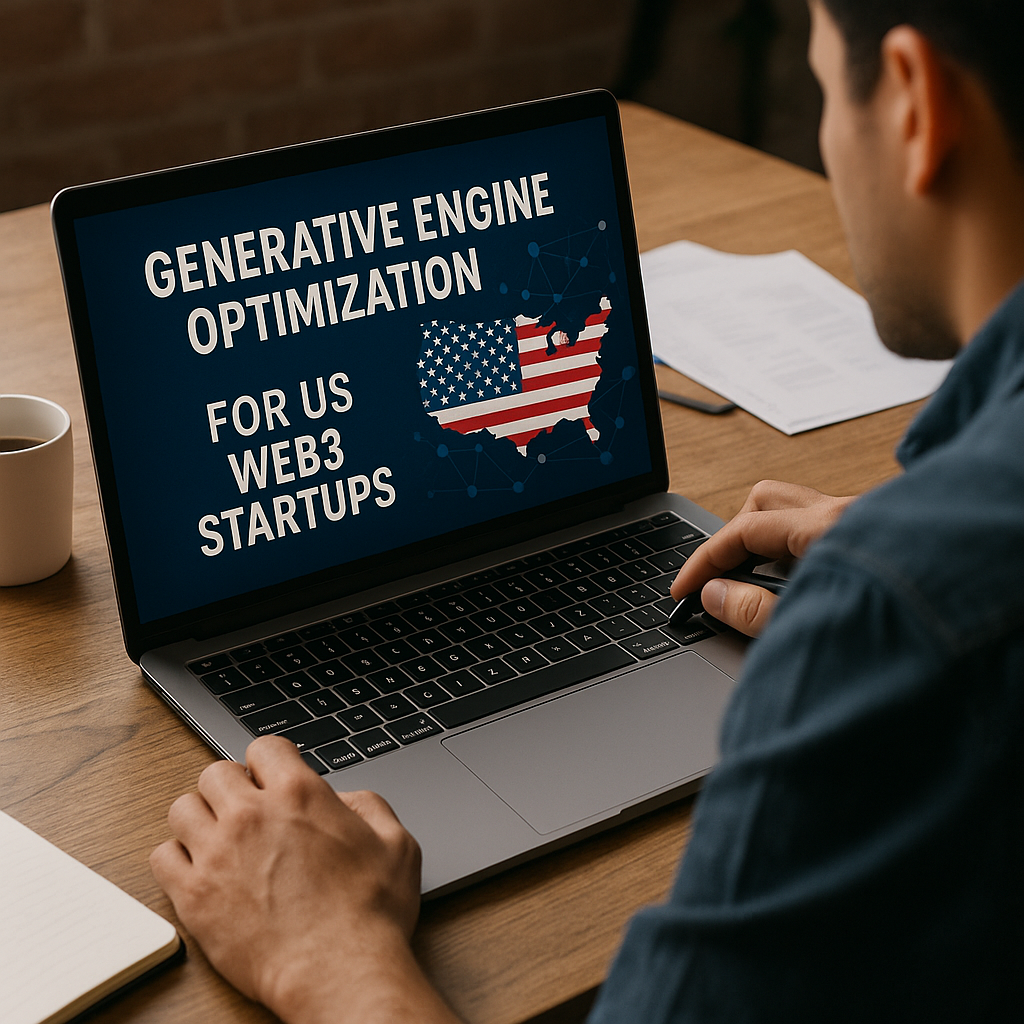
Generative Engine Optimization For US Web3 Startups is becoming a practical growth channel, not a buzzword. If your blockchain company wants to appear in AI answers from ChatGPT, Perplexity, Gemini, Claude, and Google AI Overviews, you need content that machines can understand, trust, quote, and connect to real authority signals.
What Is Generative Engine Optimization For US Web3 Startups?
Generative Engine Optimization is the process of shaping your content, entity data, citations, and brand signals so AI search engines can confidently mention your Web3 startup in generated answers. For US Web3 companies, it combines technical SEO, content strategy, schema, digital PR, compliance-aware messaging, and community authority.
Traditional SEO focuses mostly on ranking web pages. However, AI search optimization focuses on being selected as a trusted source inside synthesized answers. That matters because users now ask complex questions such as “What is the safest crypto wallet for US startups?” or “Which Web3 infrastructure companies support regulated finance?”
Generative Engine Optimization For US Web3 Startups works best when your site gives precise answers, uses consistent terminology, and proves credibility across third-party sources. In addition, AI models tend to favor brands that appear in structured databases, reputable publications, developer documentation, GitHub repositories, regulatory discussions, podcasts, and specialist communities.
For Web3, trust is especially important. The industry often touches financial risk, cybersecurity, identity, smart contracts, token economics, privacy, and sometimes healthcare applications such as patient data exchange or clinical trial consent systems. Therefore, vague claims can reduce both human trust and AI visibility.
How AI Search Engines Choose Web3 Brands to Cite
Generative engines do not “rank” companies exactly like Google’s blue links. Instead, they generate answers using patterns from crawled content, entity relationships, authoritative mentions, user queries, structured data, and retrieval systems. As a result, your startup must be easy to classify and hard to misunderstand.
According to research on information retrieval and large language models, AI systems perform better when content is clear, verifiable, and supported by citations. Similarly, experts recommend writing in a way that answers real user questions directly before adding depth.
Strong GEO signals for Web3 startups include:
- Clear explanations of your protocol, product, market, and user problem
- Consistent founder, company, and product entity information across the web
- Technical documentation that explains security, interoperability, APIs, and smart contracts
- Independent mentions from trusted crypto, finance, cybersecurity, and technology publications
- Compliance-aware language around tokens, wallets, DeFi, privacy, and user funds
- Generative Engine Optimization For US Web3 Startups included naturally in strategic pages and supporting articles
Moreover, AI answer engines often prefer content that reduces ambiguity. For example, if your startup offers decentralized identity for healthcare, explain whether you handle protected health information, how you support HIPAA-aligned workflows, and when users should consult a healthcare provider for medical decisions. This avoids risky overclaims and supports YMYL trust standards.
Generative Engine Optimization For US Web3 Startups: What should your website publish first?
Your first priority should be a tightly structured knowledge base. It should explain what the company does, who it serves, why the technology matters, and where the risks sit. In addition, every page should answer one specific search intent instead of trying to cover the whole company story.
Useful first pages include:
- A “What We Do” page that defines your category in plain language
- A security page explaining audits, bug bounties, custody, encryption, and risk controls
- A compliance page with cautious, jurisdiction-aware explanations
- Developer docs with examples, API references, and integration details
- Use-case pages for fintech, gaming, enterprise, healthcare, or infrastructure buyers
For instance, a Web3 health data startup should avoid saying its platform “guarantees better outcomes.” Instead, it can say the platform may support consent management, data provenance, patient privacy workflows, and research coordination. If the product relates to diabetes, cardiovascular disease, medication adherence, or mental health records, medical claims need extra review by qualified professionals.
Why GEO Can Outperform Traditional SEO for Early Web3 Startups
Many US Web3 startups struggle to rank against large exchanges, venture-backed protocols, and high-authority news sites. However, AI search creates new openings. A smaller company can be cited if its explanation is clearer, more specific, and better supported than larger competitors.
Generative Engine Optimization For US Web3 Startups can support growth in several practical ways:
- It helps AI tools describe your company accurately when users compare vendors
- It increases visibility in zero-click discovery journeys
- It strengthens brand authority through consistent entity signals
- It improves sales enablement because prospects find clearer answers before booking calls
- It reduces misunderstanding around token models, security, and compliance
Notably, GEO also supports investor discovery. Venture analysts, enterprise buyers, journalists, and developers increasingly use AI tools for market mapping. Therefore, a startup with structured, citation-worthy content may appear in early research even before it wins high-volume Google rankings.
Another advantage is trust compounding. When your blog, documentation, Crunchbase profile, GitHub, founder bios, podcast interviews, and media mentions all describe the company consistently, AI systems can connect those dots. Consequently, your brand becomes a more stable entity in machine-readable knowledge graphs.
What Are the Biggest GEO Risks for Web3 Companies?
The biggest risk is trying to manipulate AI systems with keyword stuffing, fake authority, or exaggerated claims. That approach can damage trust fast. In Web3, where scams and unclear token promises already concern users, overstating performance, safety, returns, or medical impact can create legal, reputational, and ethical problems.
Generative Engine Optimization For US Web3 Startups should never mean publishing thin content at scale. In fact, weak articles can confuse AI systems and dilute your topical authority. Instead, publish fewer pages with stronger evidence, better structure, and clearer answers.
Common risks include:
- Making financial claims that imply guaranteed returns or risk-free yield
- Using unclear language around custody, user funds, and wallet permissions
- Publishing security claims without audits, methodology, or limitations
- Ignoring US regulatory sensitivity around securities, DeFi, privacy, and consumer protection
- Applying Web3 to healthcare while making unsupported claims about diagnosis, treatment, or patient outcomes
If your product touches health data, medication access, wearable data, clinical workflows, or patient identity, take extra care. Studies suggest users can misinterpret digital health claims when language sounds too certain. Therefore, include plain limitations and encourage users to consult a healthcare provider for medical decisions. Your content should support understanding, not replace care.
How can a US Web3 startup build GEO authority in 30 days?
You can make meaningful progress in one month if you focus on clarity, credibility, and crawlability. Start with the pages most likely to shape how AI systems describe your company. Then support them with external proof.
- Audit your brand entity. Confirm that your company name, founders, product category, location, and descriptions match across your website, LinkedIn, Crunchbase, GitHub, X, and major directories.
- Create a clear company definition page. State what you do, who it serves, which blockchain networks you support, and what problem you solve.
- Publish five answer-first articles. Target questions such as “How does decentralized identity work for enterprises?” or “What should US startups know about smart contract security?”
- Add structured data. Use Organization, Article, FAQPage, Product, SoftwareApplication, and Person schema where appropriate.
- Strengthen trust signals. Add audit summaries, security practices, leadership bios, citations, media mentions, and transparent limitations.
- Earn third-party validation. Seek expert interviews, relevant podcast appearances, developer community mentions, and reputable industry coverage.
In addition, make your technical content easy to quote. Short definitions, comparison tables, concise FAQs, and clearly labeled sections often help AI answer engines extract meaning. However, avoid publishing unsupported predictions about token prices, regulatory outcomes, or medical benefits.
Which Content Types Help Web3 Startups Appear in AI Answers?
The best GEO content answers specific questions with evidence and context. For example, “What is account abstraction?” is useful, but “How does account abstraction reduce onboarding friction for US fintech apps?” is stronger because it targets a real buyer problem.
High-performing content types include:
- Glossaries for Web3 concepts, including smart contracts, zero-knowledge proofs, wallets, bridges, oracles, and decentralized identity
- Comparison pages that explain tradeoffs without attacking competitors
- Security explainers covering audits, threat models, private keys, and multi-signature controls
- Use-case pages for regulated industries such as finance, healthcare, insurance, and supply chain
- Founder-led commentary on policy, infrastructure, interoperability, and adoption trends
People Also Ask-style questions should guide your editorial plan. For example, users may search “How do I optimize for AI search engines?” “Why is generative engine optimization important for startups?” and “Can Web3 companies appear in Google AI Overviews?” Each question deserves a direct answer followed by practical detail.
Generative Engine Optimization For US Web3 Startups also depends on freshness. AI search systems and users both value current information in fast-changing categories. Therefore, update content when regulations shift, audits publish, products change, or blockchain ecosystems evolve.
The practical takeaway is simple. Build a web presence that explains your Web3 startup clearly, proves its trustworthiness, and answers buyer questions better than anyone else. When you combine technical SEO, entity consistency, expert content, and responsible claims, Generative Engine Optimization For US Web3 Startups becomes a durable discovery advantage.